Archives


What Type of Kids Puzzle Toys Is Best for Wholesale?

Choosing the right Kids Puzzle Toys for wholesale requires more than selecting colorful boxes. Retailers need products that balance learning value, durability, safety, and repeat demand. Circana’s 2024 Global Toy Industry report identified games and puzzles as resilient categories, supported by family play and screen-free entertainment. Grand View Research also projects continued growth in the global educational toys market, driven by parental interest in cognitive development.

Demand is promising. But product selection remains difficult.

Dr. Amanda Gummer, founder of The Good Play Guide, says, “The best toys are those that encourage children to use their imagination.” This principle matters when comparing wooden puzzles, floor puzzles, 3D construction sets, and sensory puzzle boards. A good wholesale product should offer clear age guidance, sturdy pieces, readable instructions, and packaging that survives repeated handling. It should also create a visible benefit, such as pattern recognition, fine-motor practice, or problem-solving.

The strongest assortment may combine several formats. Wooden puzzles can support premium positioning, while compact carton puzzles suit gift shops and impulse displays. Large floor puzzles may attract younger families, but they require more shelf space. That trade-off is easy to overlook.

Toy Association safety guidance and relevant testing standards should guide every purchase decision. Avoid unsupported “educational” claims. Verify materials, labeling, and age suitability with qualified suppliers. Wholesale success is not guaranteed by complexity or bright graphics. Sometimes, a simple puzzle with excellent artwork and durable pieces performs better. Product testing with real children would improve confidence, yet many buyers skip it because of time and budget pressure.
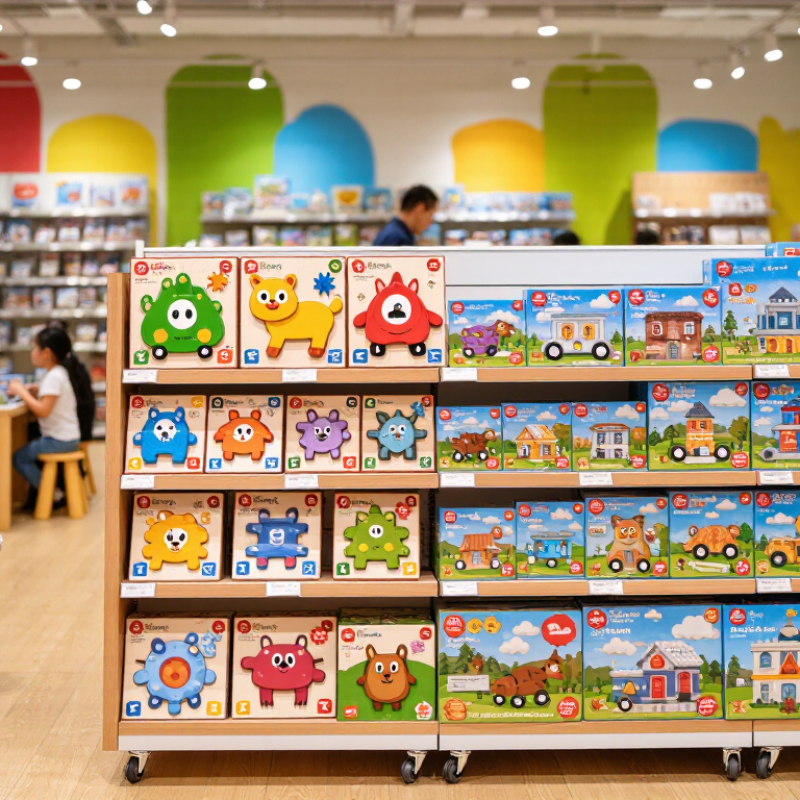
What Type of Kids Puzzle Toys Is Best for Wholesale?

Types of Kids’ Puzzle Toys Suitable for Wholesale

Wholesale buyers should prioritize puzzle types with clear age appeal, repeat purchase potential, and reliable shelf performance. According to Grand View Research’s 2024 puzzle toys market report, the global market is expected to grow steadily through 2030, supported by educational play and family entertainment. This favors classic jigsaw puzzles, wooden peg puzzles, and age-graded logic boards. Keep it simple. These products are easy to explain, store, and bundle by age.

Jigsaw puzzles suit mass retail because they offer many themes and piece counts. Wooden puzzles are useful for younger children, especially when pieces are thick, smooth, and easy to grip. Magnetic puzzles reduce loose-piece loss and work well for travel displays. Three-dimensional construction puzzles can support higher price points, but they need stronger packaging and clearer instructions. That matters. The Toy Association’s 2024 industry reporting also highlights continued interest in hands-on, screen-free play, making tactile puzzle formats relevant for wholesale assortments.

For educational retailers, logic puzzles and beginner STEM construction sets may perform well. Buyers should check solution accuracy, material durability, and age labeling before placing large orders. In my experience, attractive packaging helps secure the first sale, but weak pieces damage repeat business quickly. Not every colorful puzzle is educational. Some designs look impressive but frustrate children within minutes. A practical assortment might include simple wooden puzzles, 24–100-piece jigsaws, magnetic travel sets, and advanced logic games. The mix should reflect local age groups and retail habits, not only supplier catalogs.

What Type of Kids Puzzle Toys Is Best for Wholesale?

Wooden jigsaw puzzles and floor puzzles score highly for wholesale because they offer broad age appeal, efficient packaging, durable materials, and accessible price points. Magnetic puzzles are also suitable for retailers seeking compact, travel-friendly products, while 3D and advanced logic puzzles are better suited to more specialized buyers.

Key Features That Define High-Quality Puzzle Toys

For wholesale buyers, high-quality puzzle toys must prove more than attractive colors. Grand View Research estimated the global educational toys market at USD 57.15 billion in 2023, with strong growth expected through 2030. That demand rewards products with real learning value, not decorative complexity.

Safety remains the first filter. The U.S. Consumer Product Safety Commission estimated 231,000 toy-related emergency-room injuries among children under 15 in 2023. Wholesale puzzle toys should use secure pieces, smooth edges, non-toxic materials, and clear age guidance. Large components reduce swallowing risks for younger children. Each carton should also show batch details and reliable cleaning instructions.

Design quality matters just as much. Good puzzles offer progressive difficulty, strong color contrast, and pieces that fit without excessive force. Chunky wooden or rigid plastic pieces should survive repeated handling, drops, and classroom cleaning. Textures can support sensory exploration. Quiet play is useful in waiting rooms and learning spaces.

A bright package proves little. Test the product with children across the stated age range. Watch for frustration, loose printing, and pieces that warp after washing. One weakness remains common: some puzzles claim educational benefits without measurable skill development. Buyers should request material specifications, safety test records, and sample evaluations before placing large orders. A lower unit price may become expensive after returns, complaints, and unsold inventory.

What Type of Kids Puzzle Toys Is Best for Wholesale? - Key Features That Define High-Quality Puzzle Toys

Evaluation Dimension Recommended Wholesale Specification Why It Matters Quality Check
Safety Compliance Products should be tested for the target market’s applicable toy-safety requirements, such as ASTM F963 in the United States or EN 71 in the European Union. Documented compliance helps reduce safety, customs, and retail-distribution risks. Request current laboratory reports, conformity documents, age grading, and traceability information for the exact product version.
Age Appropriateness Use clear age labels based on piece size, assembly difficulty, motor skills, and the presence of small parts. Avoid presenting small-part puzzles as suitable for children under 3. A suitable challenge improves play value while reducing misuse and choking-related hazards. Check the age label, warning statements, piece dimensions, and instructions against the intended developmental level.
Material Quality Choose solid, splinter-resistant wood, durable food-contact-grade or toy-grade plastics where appropriate, and non-toxic coatings supported by test documentation. Reliable materials improve durability, surface safety, and repeat-purchase potential. Inspect for sharp edges, splinters, loose layers, strong odors, peeling finishes, and inconsistent coloring.
Construction and Durability Pieces should fit consistently, resist normal drops and repeated handling, and maintain their shape after assembly and disassembly. Durable construction lowers returns and supports use in homes, classrooms, libraries, and activity centers. Perform repeated assembly, drop, pull, torque, and coating-adhesion checks according to the applicable test procedure.
Puzzle Complexity Offer a balanced range: approximately 4–12 large pieces for introductory puzzles, 12–48 pieces for developing players, and higher counts for older children when the design supports it. A tiered difficulty range allows retailers to serve multiple age groups and skill levels. Check whether the visual guide, piece shape, assembly time, and challenge level match the stated age range.
Educational and Play Value Prioritize puzzles that develop visual discrimination, hand-eye coordination, fine-motor control, spatial reasoning, memory, or problem-solving. Clear developmental benefits make the product easier to position for parents, educators, and gift buyers. Confirm that the claimed skill is genuinely supported by the play activity and is not overstated in marketing copy.
Design and Inclusivity Use high-contrast artwork, easy-to-recognize themes, smooth handling surfaces, and varied difficulty options without relying on gender stereotypes. Broadly appealing designs can improve sell-through across different retail channels and customer groups. Review color contrast, image clarity, cultural suitability, accessibility considerations, and the ease of handling each piece.
Packaging and Storage Prefer compact, protective packaging with a secure storage solution such as a box, tray, drawstring bag, or reusable container. Good packaging reduces missing pieces, shelf damage, freight volume, and post-purchase complaints. Check package strength, barcode area, multilingual instructions, piece-count accuracy, and protection during carton transport.
Retail Practicality Select products with clear shelf appeal, stable packaging, a visible age range, concise instructions, and consistent case packing. Retail-ready presentation helps simplify merchandising, inventory handling, and customer selection. Confirm carton dimensions, gross weight, units per carton, packaging consistency, and the accuracy of all printed information.
Quality-Control Indicators A dependable product should have stable dimensions, consistent color and finish, complete parts, readable instructions, and documented batch control. Consistent production quality is essential for repeat wholesale orders and predictable customer satisfaction. Approve a pre-production sample, conduct random inspections, record defect rates, and retain a reference sample from each approved batch.

Note: Recommended specifications are practical wholesale benchmarks. Applicable safety requirements depend on the destination market, product materials, design, and stated age range.

Age, Skill Level, and Safety Considerations

For wholesale, the best kids’ puzzle toys match age with realistic skill demands. A three-year-old may enjoy chunky wooden pieces, large knobs, and six-piece scenes. A seven-year-old may need pattern logic, spatial rotation, or multi-step challenges. Circana’s 2023 toy industry report showed global toy sales declined 7% across tracked markets, making practical product selection more important. Retailers need puzzles that encourage repeat play, not products that look impressive once.

Safety must guide every purchasing decision. The U.S. Consumer Product Safety Commission’s 2023 Toy-Related Deaths and Injuries report estimated 231,900 emergency-department-treated toy injuries among children under 15. For younger users, wholesalers should reject tiny detachable parts, sharp corners, weak magnets, and paint that can chip easily. Clear age labels should reflect developmental ability, not only marketing language. Materials and construction should align with recognized toy-safety requirements, such as ASTM F963, while suppliers should provide traceable testing records.

Skill level needs careful testing. A puzzle that is too easy becomes shelf decoration; one that is too difficult creates frustration. Wholesale buyers can test samples with children from the intended age group and observe grip, attention, and problem-solving time. The process may reveal uncomfortable mistakes. Age bands are not perfect. Children develop unevenly. Buyers should also inspect packaging, instructions, and storage details, because missing pieces can create safety concerns and costly returns.

Material, Packaging, and Customization Options

What Type of Kids Puzzle Toys Is Best for Wholesale?

Material, Packaging, and Customization Options

For wholesale buyers, material affects safety, durability, weight, and shipping costs. Solid wood puzzles feel premium and resist repeated handling. Smooth edges and water-based coatings are essential for young children. Cardboard puzzles cost less and suit larger retail volumes. However, thin pieces can bend during transport or storage. Plastic puzzles are easy to clean, but buyers should request material details and relevant safety test reports. In my experience, unclear material descriptions often create avoidable delays.

Packaging needs to protect every piece without adding excessive volume. A rigid paper box works well for shelf display and warehouse stacking. A small cotton pouch can reduce loose pieces inside the box. It can also support reusable storage at home. Avoid oversized packaging. Empty space raises freight costs and may disappoint customers. Window packaging attracts attention, but the plastic window must remain firmly attached. Small details matter.

Customization can include colors, artwork, piece counts, instruction sheets, and box dimensions. Age labels should match the puzzle’s actual difficulty. A colorful design may attract buyers, yet confusing illustrations can weaken learning value. Add a sample assembly image and clear storage guidance. Custom shapes are possible, but unusual cuts may increase tooling costs and production time. I once underestimated the effect of one extra color layer; the result looked better, but quality checks became slower. Careful sampling is worth the effort.

How to Evaluate Wholesale Value and Market Demand

When buying kids' puzzle toys wholesale, value begins with evidence, not the lowest carton price. I compare landed cost, piece count, material quality, packaging, and expected return rates. A wooden puzzle may cost more, yet smooth edges and thick pieces can reduce complaints. Ask for samples before ordering. Test them with children in the target age group, while observing frustration, grip, and independent play. Small details matter.

Demand is easier to estimate when buyer behavior is measurable. Review search volume, competitor pricing, school-season sales, and retailer feedback. Track whether parents want animals, maps, letters, or problem-solving themes. A 24-piece puzzle may suit preschool shelves, while a 100-piece design can serve older children. Do not trust one survey. Trial orders reveal more. In my experience, stated interest often exceeds actual checkout demand.

For wholesale value, calculate sell-through at a realistic retail price, not an optimistic one. Check minimum order quantity, replenishment speed, carton damage, and storage space. Confirm age guidance, material declarations, and safety documentation for each market. Clear instructions and durable packaging support trust, but they also add cost. I have underestimated freight and overestimated novelty before. That mistake still influences my forecasts. A simple pilot, followed by weekly inventory review, gives better evidence than a large first shipment.

Close
Enter your email address to receive special offers!
linkedin facebook pinterest youtube rss twitter instagram facebook-blank rss-blank linkedin-blank pinterest youtube twitter instagram