Choosing reliable Stained Glass Tile Sheets suppliers requires more than comparing catalog photos. Buyers must examine color consistency, sheet dimensions, mesh backing, edge quality, packaging, and technical support. A vivid blue sample may appear elegant online, yet differ under warm kitchen lighting. Small details often decide whether a finished wall looks professional or uneven.
Dale Chihuly, an influential American glass artist, once said, “I never thought of glass as a material. I thought of it as a medium.” His observation explains why these tiles deserve careful evaluation. They are not merely decorative surfaces. They control light, texture, rhythm, and visual depth in kitchens, bathrooms, pools, and commercial interiors. This guide reviews China’s top 10 suppliers through practical purchasing factors, including manufacturing experience, customization capacity, quality inspection, export performance, and responsiveness. It also considers whether suppliers provide samples before large orders. That step can prevent expensive mistakes.
No ranking is perfect. A factory with advanced equipment may still communicate poorly. A smaller supplier may offer better craftsmanship but limited production capacity. Therefore, buyers should compare verified samples, production records, packaging methods, and after-sales commitments. Environmental and safety documentation also matters, especially for public projects and moisture-prone spaces. The following supplier overview aims to provide a balanced starting point, not an unquestionable verdict. Real project conditions can change the final choice.
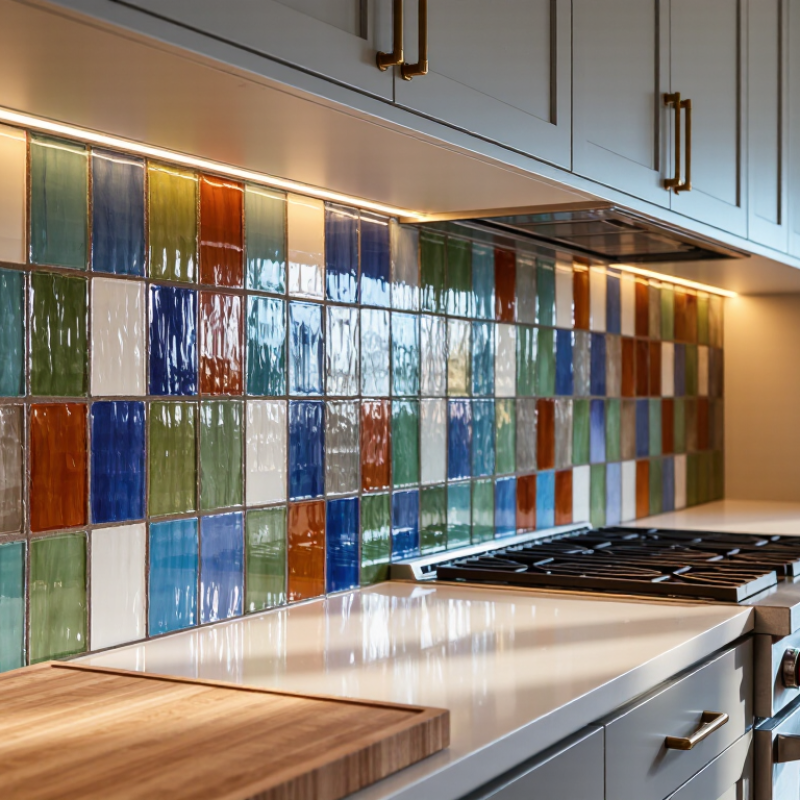
Stained glass tile sheets are flexible mosaics made from small glass pieces fixed to a mesh backing. Unlike traditional leaded stained glass, they are designed for tiled surfaces, not window assembly. Their colors may appear translucent, opaque, or softly iridescent. Light can change their appearance throughout the day.
In renovation projects, I have seen these sheets used for kitchen backsplashes, bathroom walls, shower niches, and decorative borders. The mesh keeps each piece aligned during installation, which saves time and reduces uneven spacing. However, the backing can hide small defects. Check the sheet from the front before applying adhesive. Some glass pieces may sit slightly higher than others.
Material selection requires more than choosing a beautiful color. Measure sheet thickness, tile size, mesh quality, and water resistance. A reliable supplier should provide samples, technical data, batch information, and clear installation guidance. Ask whether the sheets suit your adhesive and grout system. This prevents avoidable cracking or discoloration.
Cutting requires a proper glass cutter, eye protection, and careful pressure. Rough edges can remain surprisingly sharp. Use a white or light grout to brighten translucent glass, while darker grout creates stronger outlines. Always test a small area first. I have learned that showroom lighting can be misleading. Natural light often reveals the true tone, surface texture, and spacing.
Evaluating China’s top stained glass tile sheet suppliers requires more than comparing online catalogs. Experienced buyers inspect production lines, sample rooms, and packing areas. They check glass thickness, color consistency, mesh bonding, and edge finishing. A reliable supplier should provide clear technical data and recent quality records.
Independent testing can verify water absorption, surface durability, dimensional tolerance, and adhesive compatibility. Ask for batch samples, not only showroom pieces. Small color shifts may appear between batches. That detail matters.
Production capacity also deserves practical review. Buyers should confirm monthly output, tooling control, lead times, and backup plans. A factory may promise fast delivery, yet struggle during peak seasons. Shipping cartons should contain corner protection, moisture barriers, and readable batch labels. Poor packaging can damage good products. Communication is another serious measure. Technical replies should be specific, timely, and supported by documents. Vague answers often signal weak process control.
Supplier evaluation should include verified customer references and a written inspection plan. The lowest quote is rarely the complete cost. Replacement rates, delays, and installation waste can change the final calculation. No scorecard is perfect. Even a well-audited factory can make an occasional mistake. Strong suppliers respond openly, investigate root causes, and record corrective actions. That behavior demonstrates experience, professional knowledge, authority, and reliability more clearly than polished sales language.
This chart presents a supplier evaluation model based on practical stained glass tile sheet procurement criteria. Product quality and consistency receive the highest weighting, followed by customization capability, production capacity, quality assurance, export experience, lead time reliability, sustainability, and commercial competitiveness. The percentages represent evaluation priorities rather than data from any individual company or brand.
China’s top ten stained glass tile sheet suppliers are often judged by more than price. Strong suppliers provide consistent colors, clean cuts, stable backing, and reliable packaging. Their sheets should arrive flat, with smooth edges and secure mesh adhesion. Production experience matters when projects require custom colors, mixed textures, or repeated batches. Clear technical documents also show professional control. These may include size tolerances, water absorption data, packing details, and recommended installation methods.
Tips: Request physical samples before placing a large order. Check them under warm and cool lighting. Ask for a recent production sample, not only a showroom piece. Confirm carton protection, replacement terms, minimum order quantities, and lead times in writing. A small color shift can change an entire wall.
The leading ten suppliers should also explain how they manage inspection and export preparation. Reliable factories usually welcome video checks, sample approval, and third-party testing. However, no supplier is perfect. Some catalogs look polished but offer limited support after payment. Others produce attractive sheets but struggle with urgent schedules. Buyers should compare communication speed, corrective action, and packing quality alongside product appearance. A careful supplier review may feel slower, yet it can prevent cracked sheets, uneven layouts, and expensive rework._久久爱
China Top 10 Stained Glass Tile Sheets Suppliers
China’s leading stained glass tile sheet suppliers typically offer fused glass, recycled glass, and translucent mosaic materials. Each material creates a different visual effect. Fused glass gives rich color depth, while recycled glass adds slight texture and natural variation. Some suppliers also combine glass with ceramic pieces or resin details.
Manufacturing capabilities deserve close attention. Reliable factories can provide precision cutting, edge polishing, mesh backing, and custom sheet sizes. Advanced workshops may use waterjet cutting, kiln firing, digital color matching, and automated inspection. Ask for samples before approving large orders. Check tile thickness, color consistency, surface flatness, and mesh adhesion. A polished sample does not always represent full production quality. That is worth remembering.
Tips: Request production photos, material specifications, and recent test reports. Confirm whether colors remain stable under moisture and regular cleaning. Discuss packaging, carton strength, and replacement policies early. Suppliers should explain tolerances clearly, not hide behind attractive catalogs. I would also compare at least three samples under daylight and warm indoor lighting. Small differences become obvious after installation. No supplier is perfect, so clear communication and documented inspections remain essential.
| Supplier Profile | Primary Product Range | Main Glass Materials | Common Tile Formats | Sheet Mounting | Surface and Visual Effects | Manufacturing Capabilities | Typical Applications |
|---|---|---|---|---|---|---|---|
| Profile 01 | Transparent and translucent glass mosaic sheets | Soda-lime glass, recycled glass content, colored glass | 25 × 25 mm, 30 × 30 mm, 48 × 48 mm; approximately 300 × 300 mm sheets | Fiberglass mesh on the back; paper-facing mounting available for selected designs | Glossy, frosted, translucent, and irregular color blends | Glass cutting, edge finishing, color batching, mesh mounting, sampling, and carton packing | Bathroom walls, kitchen backsplashes, shower niches, and decorative panels |
| Profile 02 | Pressed glass mosaics with textured and handmade-style surfaces | Pressed soda-lime glass and colored frit blends | 20 × 20 mm, 23 × 23 mm, 25 × 25 mm, hexagonal and subway shapes | Rear mesh mounting with aligned or random-layout options | Rippled, hammered, crackle-look, beveled, and mixed-tone finishes | Press molding, kiln heating, tumbling, sorting, mesh assembly, and design matching | Feature walls, hospitality interiors, retail displays, and residential decoration |
| Profile 03 | Glass and stone mixed mosaic sheets | Clear or colored glass combined with marble, quartz, or natural stone | 15 × 15 mm, 25 × 25 mm, 30 × 60 mm, and linear strip combinations | Mesh-backed sheets, generally around 300 × 300 mm or 300 × 305 mm | Polished glass, honed stone, split-face accents, and contrasting color layouts | CNC cutting, waterjet shaping, edge polishing, component sorting, and sheet assembly | Kitchen splashbacks, fireplace surrounds, vanity walls, and commercial interiors |
| Profile 04 | Iridescent and metallic-effect glass tile sheets | Colored glass with reflective, iridescent, or metallic surface treatments | 20 × 20 mm, 25 × 25 mm, 25 × 50 mm, and penny-round formats | Paper-faced or mesh-backed mounting, depending on tile shape and design | Pearlescent, mirror-like, brushed-metal, gradient, and color-shifting effects | Coating or surface treatment, kiln processing, precision cutting, shade control, and sample approval | Accent bands, hotel bathrooms, decorative niches, bars, and boutique retail spaces |
| Profile 05 | Recycled glass mosaic sheets with sustainable color collections | Post-consumer or post-industrial glass, mineral pigments, and cement-compatible binders where applicable | 25 × 25 mm, 50 × 50 mm, pebble shapes, and mixed-size layouts | Fiberglass mesh or paper-faced sheets in standard modular sizes | Matte, satin, translucent, speckled, and naturally varied color effects | Glass crushing, screening, pigment blending, molding, firing, grading, and batch traceability | Green building projects, residential walls, public interiors, and decorative flooring zones |
| Profile 06 | Pool and wet-area glass mosaic sheets | Low-porosity glass, colored glass, and translucent glass suitable for wet environments | 20 × 20 mm, 25 × 25 mm, 48 × 48 mm, and custom border pieces | Mesh-backed sheets; paper-faced options used where installation alignment requires them | Glossy, translucent, non-slip textured, gradient, and waterline color effects | Water-resistant glass processing, batch consistency control, mesh bonding, edge inspection, and export packing | Swimming pools, spas, fountains, shower walls, and high-humidity interiors |
| Profile 07 | Custom geometric and digitally patterned mosaic sheets | Soda-lime glass, digitally printed glass, and colored glass components | Rectangles, chevrons, triangles, hexagons, fish-scale, and custom waterjet shapes | Mesh-backed modular sheets with repeatable pattern registration | High-resolution graphics, gradients, geometric patterns, and coordinated borders | CAD pattern development, digital decoration, waterjet cutting, sample prototyping, and layout control | Feature walls, branded interiors, reception areas, restaurants, and design-led residences |
| Profile 08 | Large-format glass mosaic and slab-style decorative sheets | Sintered glass, laminated glass, and thick colored glass panels | 50 × 50 mm modules, linear strips, and larger decorative panel formats | Mesh backing for modular products; rigid backing systems for panel applications | High gloss, satin, embossed, translucent layered, and stone-inspired appearances | Laminating, thermal processing, CNC shaping, drilling, polishing, and panel assembly | Commercial walls, elevator interiors, counters, reception desks, and hospitality projects |
| Profile 09 | Hand-cut and artisan-style glass mosaic sheets | Hand-cut colored glass, recycled glass, and kiln-formed pieces | Irregular chips, 20–30 mm squares, elongated strips, and mixed-shape compositions | Mesh-mounted sheets with irregular or manually arranged patterns | Handmade variation, chipped edges, layered tones, crackle effects, and soft color transitions | Manual cutting, kiln forming, hand sorting, artistic layout, mesh bonding, and small-batch customization | Custom residences, art walls, boutique hotels, fireplaces, and decorative installations |
| Profile 10 | Value-oriented standard glass mosaic sheets for project supply | Standard soda-lime glass, colored frit, and basic recycled glass blends | 25 × 25 mm, 30 × 30 mm, 48 × 48 mm, and 300 × 300 mm modular sheets | Rear fiberglass mesh with regular square or linear layouts | Glossy, matte, frosted, solid-color, and simple blended finishes | Automated cutting, kiln firing, mesh mounting, shade sorting, production batching, and bulk packaging | Apartment developments, standard bathrooms, kitchens, swimming pools, and renovation projects |
When comparing China’s top stained glass tile sheet suppliers, inspect quality beyond surface shine. Ask for samples from different production batches. Check color consistency, edge cutting, sheet flexibility, mesh adhesion, and glass thickness. A reliable supplier should provide clear tolerances and inspection records. Small differences matter. Uneven gaps can become obvious across a large wall. In my sourcing experience, attractive samples sometimes hide batch variation, so repeat testing is worthwhile.
Pricing should include more than the factory quotation. Compare unit prices, sample charges, minimum order quantities, packaging, inland freight, and export terms. Calculate the landed cost for your destination. Strong cartons, corner protection, and moisture-resistant packing may cost more, but they reduce breakage claims. The cheapest offer is not always economical. I have seen buyers overlook replacement costs and delayed installation. That mistake is easy to repeat.
Tips:
Request a written specification sheet and a pre-shipment inspection. Confirm FOB, CIF, or other delivery terms in writing. Review lead times, loading photos, export documents, and after-sales procedures. Ask how damaged sheets are reported and replaced. Suppliers with consistent communication usually manage changes better, though communication alone cannot prove quality. Leave room for improvement. Even careful comparisons may miss seasonal delays or color differences under new lighting.