China Top 10 Army Winter Sweater Manufacturers
Selecting a reliable supplier for an Army Winter Sweater requires more than comparing prices or catalog photos. Buyers need to examine yarn composition, knit density, seam strength, sizing consistency, and performance in cold, damp conditions. A sweater may look substantial on a screen yet feel thin after repeated wear. Details matter. This guide introduces ten China-based manufacturers and considers their product focus, production capabilities, customization options, and quality-control practices. The goal is to help procurement teams ask better questions, not to treat a ranking as a guarantee.
Supplier information can change, and capabilities vary by order size, season, and factory. Readers should request current specifications, sample garments, and clear answers about testing and inspection before making a decision. Check whether fabric details, color options, labeling, and delivery schedules match the intended use. Ask how defects are handled, too. No supplier is perfect, and a polished website cannot replace evidence from a sample or a documented process. That is worth remembering. The manufacturers featured here offer starting points for further evaluation, rather than automatic endorsements. A careful comparison can reveal practical differences in warmth, fit, durability, and service. Those differences may seem small at first. In the field, they can shape comfort and service life.
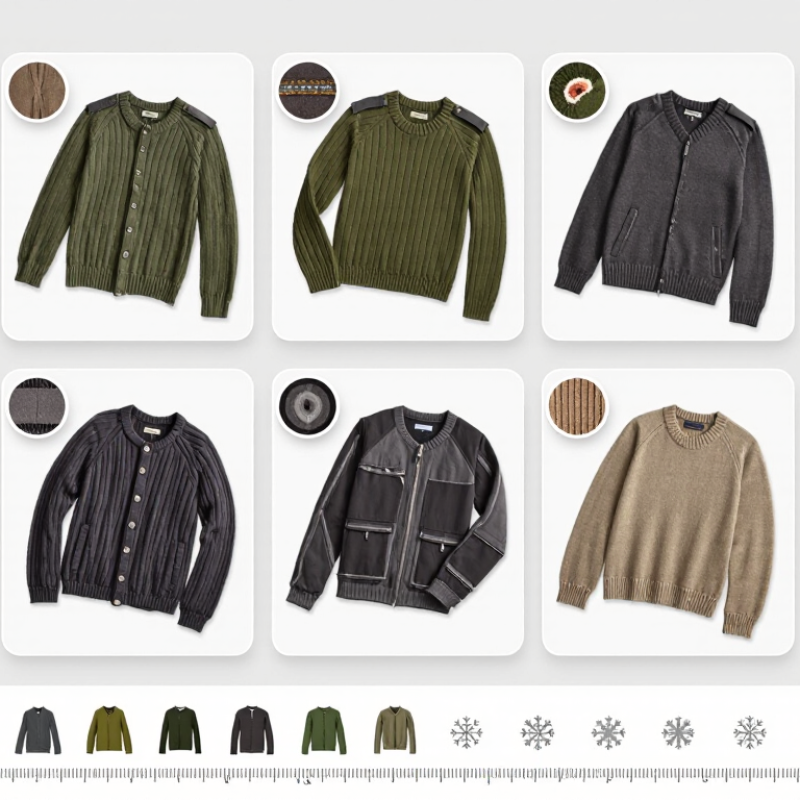
What Army Winter Sweaters Are and How They Are Used
An army winter sweater is a knitted insulating layer, not a complete cold-weather system. It traps still air near the body and adds warmth beneath a shell or over a base layer. The U.S. Army’s ECWCS technical manual describes a seven-layer clothing system for conditions ranging from about 40°F to −60°F, depending on the layers selected. That range is a system guideline, not a promise that one sweater works at every temperature. Fit matters.
In use, the sweater should allow easy arm movement and leave room for other layers. Soldiers may wear it during outdoor duty, vehicle work, or pauses between tasks, adjusting layers as activity and weather change. NIOSH’s Criteria for a Recommended Standard: Occupational Exposure to Cold Environments stresses protective clothing and keeping garments dry.
Damp cuffs can feel cold fast. Check sleeve length, collar comfort, and whether a pack presses the knit against the shoulders. A tight fit may restrict layering; an oversized one can bunch beneath equipment. Small details count.
Procurement teams should assess fabric composition, seam strength, shrinkage, and care instructions with wear trials. A lab result is useful, but it cannot fully reproduce a windy watch or a wet snow shift.
Materials, Construction, and Performance Requirements
An army winter sweater needs warmth without restricting movement beneath a coat or load-bearing equipment. Fine wool traps insulating air and helps manage moisture, while nylon or polyester can improve abrasion resistance and drying time. Blends are practical, but the ratio matters: too much synthetic fiber may feel clammy during hard activity. Wet wool still insulates.
Construction determines whether those materials hold up. Dense, even knitting reduces cold spots, while reinforced shoulders and elbows resist rubbing from straps and repeated contact. Ribbed cuffs should stay snug without cutting circulation. A high collar can protect the neck, but it must not interfere with outerwear or safe movement. Small details matter.
Performance checks should include shrinkage after washing, pilling, seam strength, and drying time. Testing a sweater only in a warm room misses its real weaknesses. A controlled cold-weather trial can reveal whether the fabric stays comfortable through alternating activity and rest. Fit also changes performance: excess looseness lets warmth escape, while a tight chest can restrict layering. Specifications look precise on paper; actual comfort can vary between wearers.
How Army Winter Sweaters Are Manufactured in China
Manufacturing an army winter sweater in China begins with a technical specification, not a knitting machine. It sets yarn composition, garment weight, color, size range, and reinforcement points. Requirements vary by order. Incoming yarn is checked for shade, thickness, and uneven fibers; a small mismatch can affect a whole batch. Knitting machines form the body and sleeve panels while operators monitor tension and stitch density. Too loose, and warmth may escape. Too tight, and movement can feel restricted. Panels are linked, seams reinforced, and cuffs and necklines shaped before washing or finishing. Small adjustments matter.
After finishing, quality teams inspect measurements, stitching, surface appearance, and shrinkage. Samples may also be checked for pilling, colorfastness, and seam strength, depending on the agreed specification. Fit trials over base layers can reveal tight shoulders or sleeves that ride up. A test report helps, but it cannot capture every wearer's comfort. That remains an imperfect part of production. When measurements fall outside tolerance, the factory can review machine settings, yarn lots, or finishing conditions before releasing the batch. Clear records help buyers trace defects to a production stage and request practical corrections.
China’s Top 10 Army Winter Sweater Manufacturers
China’s Top 10 Army Winter Sweater Manufacturers are best compared by production control, material knowledge, and consistency—not price alone. A capable factory should explain yarn composition, knit structure, shrinkage limits, and how garments are checked after washing. Ask for a sample in the intended weight and color. Feel the cuffs and collar; these areas often reveal uneven tension or loose finishing.
Winter military-style sweaters may use wool blends or durable synthetic fibers, depending on warmth, care requirements, and intended wear. Request clear size charts, fabric test details, and written information about colorfastness and pilling. Production capacity matters, but so does communication when specifications change. Look for documented quality checks at knitting, linking, and final inspection. Small details count.
A shortlist of ten Chinese manufacturers should be treated as a starting point, not a guarantee of equal performance. Visit or independently verify facilities where practical, and compare samples against the same checklist. A tidy sample can hide inconsistent bulk production. That is easy to overlook. Even experienced buyers may need to revise their first choice after testing garments through repeated wear and laundering.
China Top 10 Army Winter Sweater Manufacturers - China’s Top 10 Army Winter Sweater Manufacturers
This non-ranked comparison framework contains no company or brand names. It outlines verifiable product and quality criteria for evaluating army winter sweater suppliers; test methods and acceptance limits should be specified for each procurement.
| No. | Evaluation Dimension | What to Check | Relevant Test or Reference |
| 1 | Fiber composition | Confirm the declared percentages of wool, acrylic, polyester, nylon, or other fibers against the product specification. | ISO 1833 series for quantitative chemical analysis of textile fiber mixtures; select the applicable part for the fiber blend. |
| 2 | Fiber identification | Check that fiber names used on specifications and labels follow recognized generic terminology. | ISO 2076 provides generic names for manufactured fibers. |
| 3 | Fabric construction | Inspect knit structure, gauge, stitch consistency, surface defects, and overall construction against an approved sample. | Documented visual inspection and comparison with the approved production sample. |
| 4 | Fabric mass | Measure fabric mass per unit area and verify it against the agreed product specification. | Use a documented sampling and conditioning procedure; report results in grams per square metre. |
| 5 | Pilling and surface wear | Assess whether the knitted surface develops pills, fuzz, or matting during abrasion. | ISO 12945-2 specifies a modified Martindale method for assessing fabric pilling, fuzzing, and matting. |
| 6 | Colorfastness to laundering | Check color change and staining after the agreed washing conditions. | ISO 105-C06 covers colorfastness to domestic and commercial laundering. |
| 7 | Colorfastness to perspiration | Evaluate color change and staining under acidic and alkaline perspiration test conditions. | ISO 105-E04 covers colorfastness to perspiration. |
| 8 | Dimensional change after care | Measure garment or fabric dimensional change after the specified washing and drying procedure. | ISO 6330 describes domestic washing and drying procedures used in textile testing. |
| 9 | pH of aqueous extract | Check the pH of the aqueous extract as part of the agreed chemical and product-safety inspection. | ISO 3071 specifies determination of the pH of aqueous extracts of textiles. |
| 10 | Care information and labeling | Verify that care instructions are clear and consistent with the product’s tested care requirements and destination-market rules. | ISO 3758 provides a system of care-labelling symbols for textiles. |
How to Compare Suppliers and Verify Product Compliance
When comparing suppliers of army winter sweaters, look beyond unit price and catalog photographs. Request a production sample in the intended yarn blend, color, and size range. Check sleeve length, collar recovery, seam strength, and how the fabric feels after washing. Small differences matter.
Ask suppliers for current test reports covering fiber content, dimensional change, pilling, and colorfastness. Confirm that each report identifies the tested material and matches the sweater you plan to order. A polished PDF is not enough. Verify the issuing laboratory and report date, and arrange independent testing when order size or risk justifies it. I would recheck this step, even when a supplier seems experienced.
Compliance depends on the destination market and the product’s intended use. Request applicable labeling details, care instructions, and records linking production lots to materials. Compare answers across suppliers; vague claims such as “fully compliant” need supporting evidence. Some paperwork may arrive late. That is a warning sign, not proof of misconduct, but it deserves follow-up. Keep written specifications for yarn weight, measurements, tolerances, and inspection criteria before approving bulk production.
China Army Winter Sweater Suppliers: Comparison & Compliance Checklist
Suggested weighting for comparing suppliers of military-style winter sweaters
These buyer-defined evaluation weights are a comparison framework, not market statistics or scores for specific manufacturers. Verify test reports and traceability independently; applicable requirements for fiber content, restricted substances, colorfastness, and dimensional stability depend on the destination market and purchase specification.
