What Are the Top 10 Types of Business Flags?
Business Flags do more than mark a storefront. A feather flag beside a busy sidewalk, a crisp wall banner behind a reception desk, or a row of vehicle flags can make a business easier to notice. Each format serves a different purpose, and the right choice depends on location, audience, weather exposure, and viewing distance.
The Outdoor Advertising Association of America reported that U.S. out-of-home advertising revenue reached a record $9.1 billion in 2024, up 4.5% from the previous year. That figure covers a broad advertising category, not the business-flag market alone. It does, however, show why visible, place-based messaging remains relevant. A separate Grand View Research report valued the global digital-signage market at $26.1 billion in 2023, reflecting another shift in how businesses communicate in physical spaces. These figures offer context, not a direct measure of flag sales.
Brand strategist Marty Neumeier writes, “A brand is not what you say it is. It’s what they say it is.” A flag cannot carry a whole brand by itself. But its color, message, fabric, and placement all shape a quick impression. Small details matter. This guide compares ten common types of Business Flags, from teardrop and feather styles to pennants, pole flags, and promotional hand flags. It considers where each works best, what trade-offs to expect, and which practical details are easy to overlook. The categories are not perfectly neat; some products overlap. That is worth remembering when comparing suppliers.
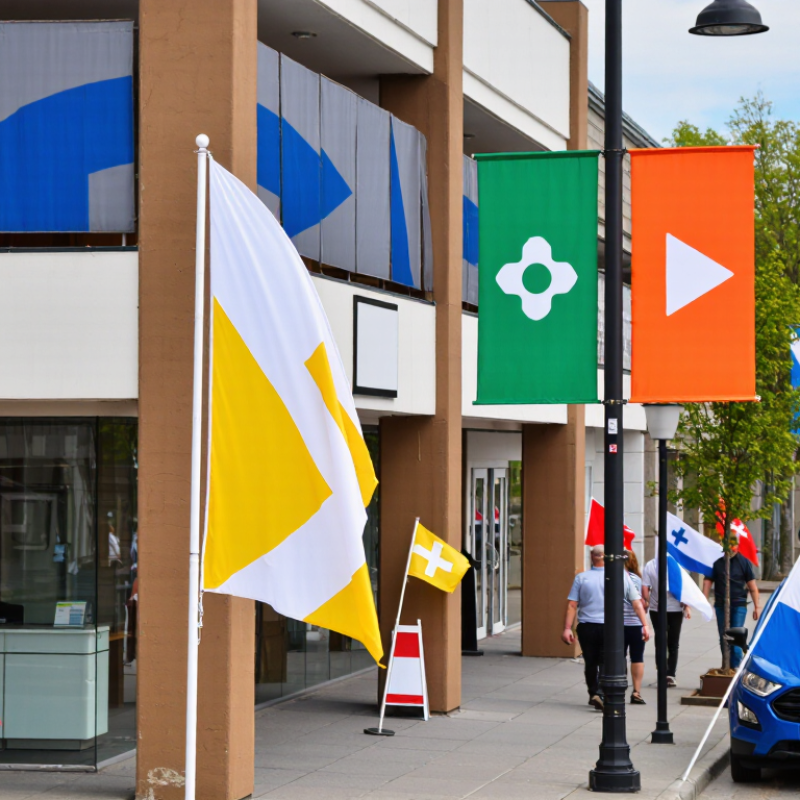
Classify Business Flags by Purpose, Mounting System, and Display Format
Business flags are easier to choose when classified by how they work, not just how they look. A practical top-ten list includes storefront, promotional, event, directional, feather, teardrop, rectangular, pole-mounted, wall-mounted, and tabletop flags. Some categories overlap. A feather flag, for example, may promote a sale outside a shop.
Purpose determines the message and placement. Storefront and directional flags help visitors find an entrance, while event and promotional flags attract attention in busy areas. Display format affects visibility: feather and teardrop shapes suit narrow walkways, while rectangular flags provide more room for text. Mounting matters too. Pole-mounted flags move in the wind, wall-mounted flags stay close to a building, and tabletop flags work indoors. Small details count. Check the viewing distance, available clearance, and expected wind exposure before ordering. A design that looks clear on a screen may be hard to read across a parking lot.
Tips: Keep the main message brief, use strong contrast, and match the base to the surface. Measure twice. I would also test a printed sample when color accuracy matters; screens can be misleading.
Compare 10 Common Types, from Feather and Teardrop to Desk Flags
Business flags differ in shape, height, and viewing distance. Feather flags are tall and narrow, with curved tops that stay legible from a roadside. Teardrop flags hold their shape in light wind, though their compact print area limits detailed messages. Rectangle and sail flags offer broader panels for pricing or event names. Blade flags suit storefronts where pedestrians approach from the side. Pole flags provide height, while fabric banners can span entrances or fences. Pull-up flags work indoors and pack away quickly. Tabletop flags mark registration desks; small desk flags identify reception areas or meeting rooms. Small, but useful.
Selection should follow the site, not fashion. The 2012 FedEx Office survey found 76% of consumers had entered a store they had not visited before based on its signs; 68% said a sign prompted a purchase. These findings concern signs broadly, not flags specifically. The Outdoor Advertising Association of America reported U.S. out-of-home advertising revenue of $9.1 billion in 2023, evidence of ongoing investment in visible media, but not proof that any single flag type performs best. Measure viewing distance, wind exposure, and setup time before ordering. A feather flag may catch attention beside a road, yet look crowded on a narrow sidewalk. That tradeoff is easy to miss.
Assess Fabric Air Permeability with ASTM D737 Test Data
Business flags include feather banners, teardrop flags, rectangular street flags, and compact pennants. Their shapes and seams affect how fabric moves in wind. ASTM D737 measures air permeability by recording airflow through a fabric under a controlled pressure difference. The result helps compare materials before production. It does not predict every flag’s behavior outdoors.
Check the reported test area, pressure setting, units, and number of specimens. Compare samples tested under the same conditions; otherwise, the figures may mislead. A more permeable fabric may release wind more readily, while a tighter weave can feel heavier and hold its shape differently. That matters. Ask for test data from the actual fabric, not a similar-looking swatch. Then inspect stitching and printed areas, which can alter airflow across a finished flag. The test is useful, but it is not the whole answer. Real wind, mounting height, and fabric wear still change performance. I would treat a single result as a starting point, not a guarantee.
Check Printed-Color Durability Against AATCC TM16 Lightfastness Standards
What Are the Top 10 Types of Business Flags?
Check Printed-Color Durability Against AATCC TM16 Lightfastness Standards
A flag can look vivid indoors and fade quickly on a sunny storefront. Polyester, nylon, mesh, and cotton fabrics may respond differently to sunlight, even when printed with similar colors. Ask for a lightfastness report on the actual fabric and ink combination, not a generic material sheet. AATCC TM16 uses xenon-arc light to assess textile colorfastness to light. Test results depend on the selected exposure option, so hours alone do not make two reports comparable.
Check the report’s test option, irradiance, exposure duration, and color-change rating. Where available, request before-and-after color measurements, such as ΔE calculated using ASTM D2244. That gives buyers a numerical comparison, though it does not replace viewing the flag under consistent lighting. AATCC TM16 is a test method, not a universal pass grade; set a project-specific limit before production. For example, a short-term event flag may tolerate more fading than a sign expected to fly through a full summer. A small detail matters: printed red can shift before nearby black looks changed. Reports should identify the tested color and fabric, or the data may mislead. Ask for the raw results. They are useful.
10 Common Business Flag Types: AATCC TM16 Testing
A flag style alone does not determine printed-color durability. Each printed fabric and color system needs product-specific testing.
How to read: 1 means a product-specific test is needed; it is not a durability score. AATCC TM16 results depend on the tested material, print system, test option, and exposure conditions. Compare actual lab results only when the methods and conditions match.
Match Flag Dimensions and Aspect Ratios to Manufacturer Specifications
For business flags, confirm the manufacturer’s finished dimensions and aspect ratio before approving artwork. Aspect ratio means fly length divided by hoist height; a 3 × 5 ft flag is 1.67:1. Do not assume every supplier uses the same format. A 2023 U.S. government specification, Executive Order 10834, sets the national flag’s proportions at 1.9:1, but that ratio is not a universal business-flag standard. Ask for the finished-size drawing, not just the nominal size. Small detail, big difference.
Check how the flag will be installed. A 2 × 3 ft banner on a short wall bracket needs different proportions from a tall, narrow feather flag. Confirm whether listed dimensions include pole sleeves, hems, or finishing allowances; those can reduce the visible print area. Textile Exchange’s Materials Market Report 2023 estimates polyester made up 54% of global fiber production in 2022, a useful reminder that fabric choice is common—but fabric weight and construction still affect how a flag hangs. Request the supplier’s fabric and finishing specifications alongside its size chart. I once treated a catalog size as the artwork size. It was a poor assumption. Check the proof at actual dimensions, especially for logos near seams or edges.
