Archives


Top 10 Antique Stained Glass Panel Types for Global Buyers

Antique Stained Glass Panels bring color, history, and craftsmanship into homes, hotels, churches, and heritage interiors. Each panel can reveal a different visual language, from Victorian floral borders to Art Nouveau curves and geometric Art Deco forms. This guide introduces ten types that attract global buyers and collectors.

The categories reflect common design features, glass techniques, and historical uses. Expect jewel-like flashed glass, rippled textures, painted details, leaded outlines, and hand-cut sections. A panel showing ruby red glass beside pale amber may look simple, yet its construction can require remarkable precision. Experienced dealers usually examine the leading, solder joints, glass thickness, repairs, and frame condition before recommending a purchase.

Authenticity matters. Provenance, maker references, old photographs, and consistent aging can support a panel’s history. However, no single clue proves an object’s exact date. Surface wear may suggest age, but careless restoration can confuse the record. Photographs also hide bowing, hairline cracks, and weak cement. That is easy to overlook.

The selection considers visual appeal, practical installation, preservation needs, and buyer expectations across different regions. Some panels suit a quiet reading room. Others become dramatic focal points above a doorway or beside a staircase. Buyers should request measurements, close-up images, condition reports, and restoration details before committing. Professional conservation advice remains valuable, especially for fragile or historically significant pieces. The descriptions here are useful, but not absolute. Glass history often contains uncertainty, and responsible buying leaves room for further research.

Top 10 Antique Stained Glass Panel Types for Global Buyers

Historical Categories of Antique Stained Glass Panels

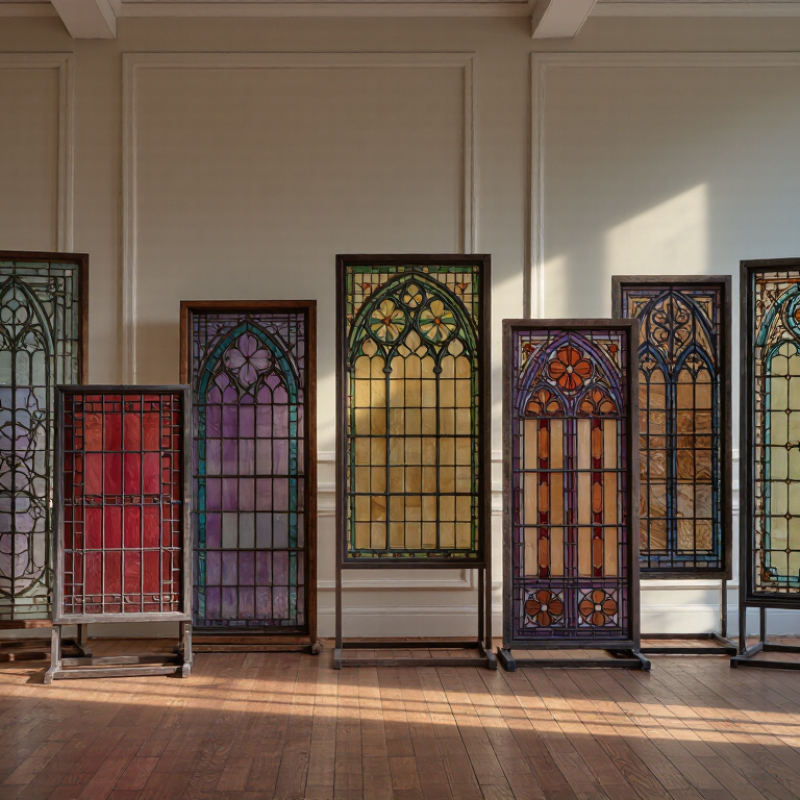
Antique stained glass panels fall into distinct historical categories, each shaped by architecture, craft, and changing taste. Ecclesiastical lancet panels often feature saints, biblical scenes, or narrow vertical designs. Rose window fragments show radial geometry and intense jewel-like colors. Heraldic panels display shields, animals, helmets, and carefully painted symbols. Domestic transom panels were made for doors, stairwells, and interior partitions. They glow softly.

Victorian figurative panels commonly combine painted faces, floral borders, and dense lead lines. Art Nouveau panels favor flowing stems, insects, irises, and asymmetrical curves. Art Deco examples use stepped forms, sunbursts, and restrained color blocks. Leaded cabinet panels are smaller works, sometimes designed for furniture or private rooms. Architectural salvage panels may come from demolished homes, chapels, schools, or commercial buildings. Their original setting can be difficult to prove.

Religious narrative panels deserve close inspection because later repairs may imitate older glass. Painted details, fired enamel, lead oxidation, and uneven glass thickness can reveal production methods. A reliable assessment should record measurements, visible repairs, frame condition, and provenance documents. Color alone proves very little. Age is complicated.

Collectors should inspect solder joints and cement residue without aggressive cleaning. A cloudy surface may reflect weathering, not neglect. Some panels have been rebuilt from mixed fragments, reducing historical unity while preserving visual appeal. I would never treat a dramatic story as evidence without supporting records. Careful comparison with regional architecture, workshop practices, and dated photographs usually produces a more defensible judgment.

Ten Notable Antique Stained Glass Panel Types

Ten Notable Antique Stained Glass Panel Types

Antique stained glass panels differ by subject, structure, and period. Ecclesiastical panels often feature saints, angels, or jewel-like ruby glass. Domestic floral panels bring roses, lilies, and curling leaves into smaller rooms. Geometric panels use repeated circles, diamonds, and strong lead lines. Landscape panels show cottages, rivers, or distant hills in layered colors. Portrait panels require careful facial painting and stable fired details. Heraldic panels display shields, symbols, and carefully arranged color fields. Transom panels were designed for doors and upper windows. Their narrow proportions remain distinctive. Some examples contain textured glass that softens daylight.

Art Nouveau panels favor flowing stems, insects, and asymmetrical movement. Art Deco examples use stepped forms, bold borders, and restrained color. These ten types can overlap. A floral panel may also follow Art Nouveau principles. That classification is not always neat.

When evaluating one, inspect the lead came, glass texture, paint survival, and replacement pieces. A genuine old panel may show uneven solder joints and gentle surface wear. However, age alone proves little. Documented provenance, consistent construction, and professional conservation records provide stronger evidence. Hold the panel near natural light, not harsh direct sun. Look for hairline cracks around corners and stress near hanging points. I have found that photographs often hide repairs. Buyers should request close images and measurements. Even experts can misread a restored section. That uncertainty deserves honest discussion before purchase, shipping, or installation.

Distinctive Designs, Materials, and Craftsmanship

For global buyers, the top ten antique stained glass panel types include Gothic lancets, floral leaded panels, opalescent sheets, Art Nouveau botanicals, Art Deco geometry, heraldic panels, ecclesiastical scenes, beveled glass, etched designs, and painted roundels. Their differences begin with materials. Hand-rolled glass often shows gentle thickness changes, bubbles, and uneven color. Cames may use lead, copper foil, or later zinc, depending on period and repair history. Texture matters.

The 2024 Art Basel and UBS Global Art Market Report valued worldwide art sales at about 65 billion dollars in 2023. Its 11.8 billion dollar online-sales figure also explains rising cross-border interest in smaller decorative works. Yet stained glass requires closer inspection than ordinary wall art. Examine solder joints, glass edges, cement residue, repainting, and frame distortion. Not every crack is historic.

My conservation experience suggests that original irregularity can support authenticity, but it never proves it. A replacement blue pane may match visually while differing under ultraviolet examination. The Getty Conservation Institute emphasizes reversible, well-documented treatment for cultural objects; buyers should request restoration records, dimensions, provenance, and condition photographs. Grand View Research identifies restoration and architectural reuse as important stained-glass demand areas, but market forecasts should not replace physical assessment. A panel with perfect symmetry may be attractive, yet excessive uniformity can signal later manufacture. That uncomfortable doubt is useful.

Top 10 Antique Stained Glass Panel Types for Global Buyers

Distinctive designs, materials, and craftsmanship across major historical production periods.

The chart shows approximate historical production windows based on established European and North American art-history periodization. Earlier panels commonly used hand-blown colored glass, lead cames, and painted grisaille details, while later Victorian, Arts and Crafts, Art Nouveau, and Art Deco examples increasingly featured opalescent glass, copper foil, enamel painting, and geometric cutting. Historical dates are approximate and may overlap by region.

How to Assess Age, Authenticity, and Condition

Top 10 Antique Stained Glass Panel Types for Global Buyers

Age begins with observation, not a dramatic story from the seller. In hands-on inspection, look for uneven glass thickness, tiny bubbles, seed-like inclusions, and irregular edges. Hand-cut pieces may show subtle tool marks. They should not look artificially repeated. Old lead came often displays a soft gray oxidation layer. Bright, perfectly uniform metal deserves questions. Yet age alone proves little. Modern reproductions can imitate these details convincingly.

Authenticity requires several clues working together. Compare the glass, solder joints, frame, and hanging hardware. Consistent aging across these parts is encouraging. Inconsistent wear may suggest later assembly or restoration. Request clear photographs, measurements, repair records, and any known ownership history. A professional conservator can identify heat damage, replacement glass, and concealed soldering. I have learned that a confident seller still needs evidence.

Condition affects both appearance and long-term care. Check for hairline cracks, loose cames, bowed sections, missing paint, and moisture marks. Hold the panel near a strong, indirect light source. Do not press the glass. Listen for rattling when the frame moves gently. That test is imperfect, but useful. A repaired panel is not automatically inferior; honest, stable repairs may preserve its character. However, fresh cement, sharp edges, or hidden breaks require careful questions before purchase. Request a condition report before international shipping. Small flaws can become expensive surprises.

Top 10 Antique Stained Glass Panel Types for Global Buyers - How to Assess Age, Authenticity, and Condition

Panel Type Common Period Typical Geographic Context Recognizable Design Features Age and Authenticity Indicators Condition Checks Buyer Assessment Priority
Gothic Revival Ecclesiastical Panel Approximately 1840–1900 Churches, chapels, and revival-style domestic architecture in Europe, North America, and other regions influenced by European design. Pointed arches, quatrefoils, tracery patterns, heraldic details, saints, biblical scenes, and rich jewel-like colors. Lead came may show age-related oxidation and uneven hand finishing. Hand-painted facial details, historically appropriate glass colors, and old reinforcing methods can support an earlier date. A documented removal from a building is especially useful. Inspect for bowing, cracked glass, loose cement, failed solder joints, corrosion of lead cames, and repairs around painted faces. Painted areas should not be excessively worn or recently overpainted. Confirm whether the panel is a complete original composition or a later reassembly. Check dimensions, provenance, and whether architectural alterations explain its removal.
Art Nouveau Floral Panel Approximately 1890–1914 Urban residences, cafés, entrances, and decorative interiors across Europe, North America, and parts of Australia. Whiplash curves, flowing stems, irises, lilies, poppies, peacock motifs, asymmetry, and opalescent or softly blended glass. Original examples often combine varied textures, streaked glass, and hand-shaped lead lines. Period soldering is generally irregular rather than perfectly uniform. A consistent relationship between design, glass texture, and construction is important. Look for fractures at tight curves, weakened perimeter leads, replacement pieces that differ in texture, and clouding or surface deposits. Opalescent glass should be assessed under natural and angled light. Compare the construction quality with the claimed period. Newer decorative panels can imitate the style, so tool marks, solder aging, glass texture, and provenance should be evaluated together.
Art Deco Geometric Panel Approximately 1919–1939 Apartment buildings, theaters, commercial interiors, and private residences in Europe and North America. Stepped forms, sunbursts, fans, strong symmetry, stylized flowers, clear geometric borders, and combinations of amber, black, blue, green, and opaque glass. Period panels commonly use machine-rolled or textured glass together with hand-cut leaded construction. Consistent geometry does not by itself prove modern manufacture; solder profile, weathering, edge treatment, and documented architectural use are also relevant. Check long straight leads for bowing, stress cracks at corners, brittle cement, and separation at joints. Large geometric sections may conceal replacement glass if viewed only from a distance. Verify whether the panel was made for a building, furniture, lighting fixture, or later decorative installation. Original framing and hardware can help establish context.
Heraldic and Armorial Panel Approximately 1700–1900, with later historicist examples Manor houses, civic buildings, religious settings, and institutional interiors in Europe and regions with European heraldic traditions. Coats of arms, shields, crests, mottos, crowns, supporters, and precise symbolic color arrangements. Authenticity depends heavily on correct heraldic design and historical context. Painted silver stain, enamel details, glass thickness, and period-style lead work should be examined. An identifiable family, institution, or building can make provenance verifiable. Inspect painted lettering, fine lines, and enamel for losses or abrasion. Check for mismatched shield sections, replacement borders, unstable paint, and assembled fragments from different panels. Research the depicted arms independently. A visually convincing panel with historically incorrect heraldry may be decorative rather than genuinely historical.
Painted Figurative Panel Approximately 1750–1900 Religious, civic, and residential interiors in Europe and colonial-era settings influenced by European glass painting. Human figures, architectural backgrounds, drapery, landscape scenes, grisaille shading, silver stain, and kiln-fired enamel painting. Traditional painted glass often shows brushwork integrated with the glass surface rather than a flat modern coating. Firing characteristics, controlled shading, historically suitable pigments, and lead construction should agree with the claimed date. Use raking light to identify paint loss, scratches, flaking, and later surface coatings. Examine hairline cracks through painted sections and signs of heat damage or aggressive cleaning. Request close photographs of painted areas from both sides. Avoid relying solely on color or apparent patina, since artificial aging and restoration can alter the visual impression.
Mosaic or Millefiori Panel Approximately 1850–1914 Decorative interiors, doors, screens, and domestic settings in Europe and North America. Small colored glass pieces, floral or star-like cane patterns, repeated tesserae, dense ornamental borders, and richly varied surface texture. True millefiori elements contain patterned glass canes visible within the material, while painted imitations do not. Original assembly methods, aged setting material, and coherent wear across the panel help distinguish an older panel from a recent reproduction. Check for loose tesserae, open joints, missing pieces, unstable backing, moisture damage, and incompatible replacement glass. Small elements can be difficult and costly to conserve. Determine whether the panel is leaded, cemented, or mounted on a later backing. Ask whether the design is complete and whether any pieces have been reset.
Beveled Glass Door or Transom Panel Approximately 1880–1930 Residential entrances, interior doors, transoms, and commercial façades in Europe, North America, and other urban building traditions. Clear or lightly tinted glass, polished bevels, geometric borders, diamonds, oval centers, and faceted light effects. Older bevels may show subtle variation in width and polish, but variation alone is not conclusive. Original lead came, corner construction, old glazing putty, and surviving hinges or frame evidence can support an early date. Inspect bevel edges for chips, star cracks, and impact damage. Check heavy panels for sagging, failed joints, loose perimeter came, and stress where the glass meets the frame. Measure accurately and establish whether the panel is intended for a standard door, transom, or custom opening. Structural safety matters when the panel will be reinstalled.
Landscape and Scenic Panel Approximately 1870–1930 Domestic interiors, memorial settings, public buildings, and decorative windows in Europe and North America. Rivers, trees, mountains, gardens, cottages, atmospheric skies, layered glass, and painted or acid-etched details. Authentic period scenes usually show deliberate variation in glass texture and hand-applied details. The scene should be technically consistent with leaded construction, kiln-fired paint, or other methods appropriate to the claimed period. Check large sky or water pieces for cracks, thermal stress, and replacement sections. Look for fading or loss of painted details, bowing, and water-related corrosion along the lower edge. Establish whether the panel was made as a window, memorial, cabinet insert, or later decorative object. Original framing can reveal its intended use.
Memorial or Commemorative Panel Approximately 1850–1930 Religious buildings, cemeteries, civic interiors, schools, and private memorial settings worldwide. Dedication texts, dates, names, symbols of remembrance, floral borders, angels, crosses, flags, or portrait-like imagery. Inscribed dates and names provide research leads but are not proof by themselves. Verify the person, event, or institution through independent historical records and compare lettering, iconography, and materials with the claimed period. Examine lettering for repainting, missing enamel, abrasion, and cracks caused by stress near borders. Check whether the dedication area is original to the surrounding composition. Prioritize provenance and documentary research. Memorial panels may have been moved, repaired, or reconstructed, so the history of ownership and installation is essential.
Lead Came Cabinet or Furniture Panel Approximately 1880–1930 Cabinet doors, bookcases, screens, lamps, sideboards, and interior furnishings in Europe and North America. Small-scale floral, geometric, or figurative designs adapted to compact rectangular, oval, or arched formats. Scale, construction, and surviving hardware can help distinguish a purpose-made furniture panel from a window fragment. Original came thickness, soldering, backing, and evidence of attachment should be consistent with the claimed furniture use. Look for fatigue from handling, cracked corners, loose came, missing glazing clips, corrosion, and pressure marks from an ill-fitting frame. Check whether the panel has been cut down from a larger window. Assess the panel and frame separately. A later frame can obscure original edges, while an altered panel may have reduced historical and practical value.

Assessment note: Date estimates are broad and can overlap. For international purchases, request front-and-back photographs, exact dimensions, weight, repair history, provenance records, and professional conservation advice before committing to a purchase or shipment.

Global Buying, Pricing, Shipping, and Conservation Factors

Top 10 Antique Stained Glass Panel Types for Global Buyers

Global buyers often compare ecclesiastical lancets, heraldic panels, floral scenes, geometric medallions, and grisaille work. Art Nouveau, Art Deco, portrait, roundel, and architectural transom panels also attract collectors. The 2024 Global Art Market Report estimated worldwide art sales at about 65 billion US dollars in 2023. However, stained glass prices remain highly uneven. A signed provenance, original leadwork, documented restoration, and rare glass can raise value sharply. Decorative appeal alone is not enough.

Inspect repairs under natural light. Look for cloudy glass, cracked solder, bowing, and replacement pieces. Conservation reports from professional heritage bodies stress reversible treatment and compatible materials. A panel with excessive cement may look stable but hide future stress. That risk deserves a price reduction. I would not trust vague claims such as “museum quality” without photographs and records.

Shipping requires more than a wooden crate. Use a rigid inner frame, vibration control, corner protection, and moisture barriers. UNCTAD’s Review of Maritime Transport 2024 describes continuing route disruption and freight uncertainty, so delivery budgets need contingency funds. Export paperwork, insurance, and customs classification also vary by destination. The World Bank’s 2023 Logistics Performance Index shows major differences in tracking, customs, and delivery reliability. Buyers should request condition images before packing and after arrival. Mistakes still happen. Good documentation makes disputes smaller.

Close
Enter your email address to receive special offers!
linkedin facebook pinterest youtube rss twitter instagram facebook-blank rss-blank linkedin-blank pinterest youtube twitter instagram